Playable demo
Maqam Box
A pastel desktop instrument for Arabic and Turkish maqam music — quarter-tone keys that bend and roll like an oud, phrase pads that play each maqam's real vocabulary, a looper to build a piece, and a companion explainer that shows how the cells join into a maqam.
Maqam Blocks — the explainer
The same twelve maqamat taken apart: stack cells on a ring of quarter tones and watch each one appear, then hear its chords and phrases.
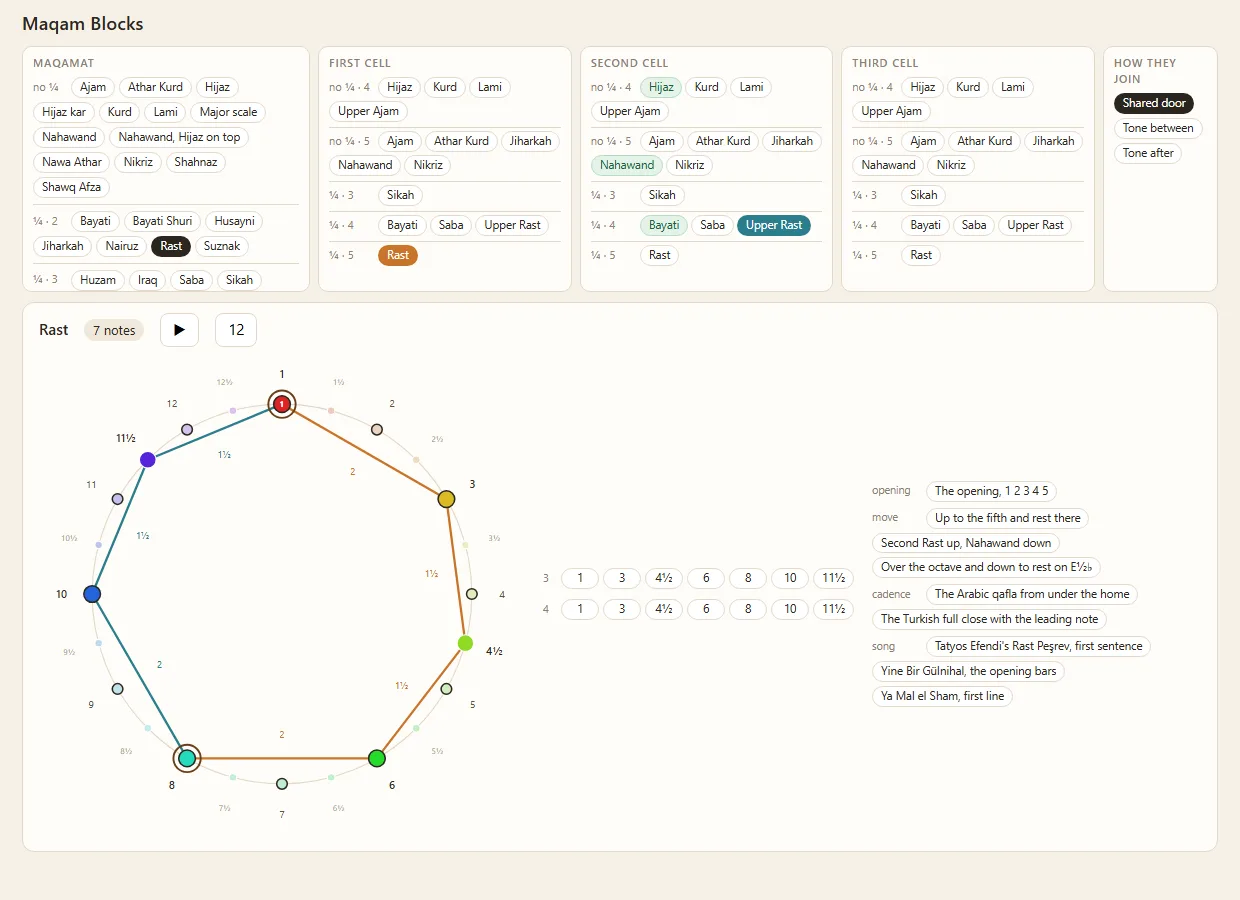
A maqam is not a scale. It is a set of small cells of three to five notes, each with its own intonation, chained together, plus a customary path through them: a way in, a cell to sit in, a move to the next cell, a rest, a way home. Most Western instruments can’t even play the notes — the half-flat third of Rast sits between two piano keys — so I built one that can.
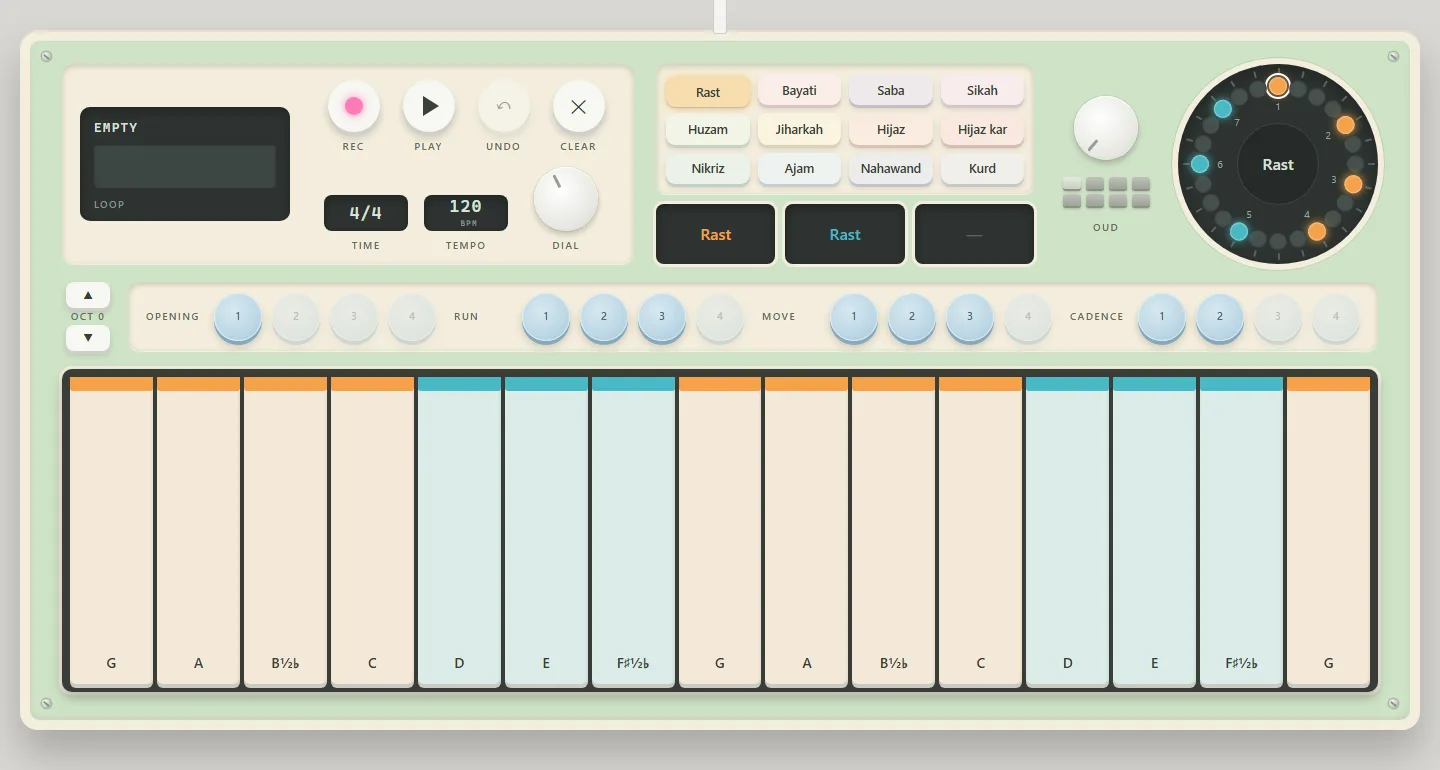
Maqam Box is the instrument. Pick a maqam and the keyboard becomes its notes, quarter tones included, with each key coloured by the cell it belongs to and the three cells named on screens beside it. The keys play like an oud string: slide between them, shake a finger sideways for an upward bend, push up into the top half of a key and the note repeats faster and faster, with the swing set by where your finger rests. Sixteen pads hold the maqam’s phrases — openings, runs, cadences and moves — each one stepping through its notes a press at a time, so you can place them in your own rhythm. A looper with a count-in, overdubs and undo turns it into a piece, and four percussion instruments (darbuka, riq, daf, kit) give it a floor to stand on.
Maqam Blocks is the companion explainer: a ring of twenty-four quarter tones where you stack cells one on another and watch a maqam appear, hear its chords, and play the same phrases traced round the ring, with the notes outside the scale marked. It is the second playable piece below.
The phrases are the heart of both. Rather than invent licks, I collected about 200 candidate phrases from written sources — Turkish seyir examples and scores, Arabic transcriptions, Sami Abu Shumays’s maqam analyses, Greek bouzouki notation — and had each one checked twice: once that it is really the maqam and not the scale run up and down, once that the source really contains it. Ninety survived. Every sound, strings, winds and drums alike, is synthesized in the browser: a plucked-string model for the oud and qanun, a breathy pipe for the ney, pitch-swept tones and shaped noise for the drums.
The look borrows from the Nopia MK1, a small sage-green hardware keyboard: flat panel, white knobs, slot buttons, round pastel pads, drawn entirely in CSS from a sketch on paper.
Want someone who builds like this?
I'm open to opportunities. Tell me what you're building — I answer every email.