Playable demo
At the Speed of Light
How does a cup in Israel reach a friend in America in a blink? Follow it down the ladder — picture, numbers, ones and zeros, light — through a cable on the ocean floor and back up to meaning. Double-tap the ocean for a hidden arcade.
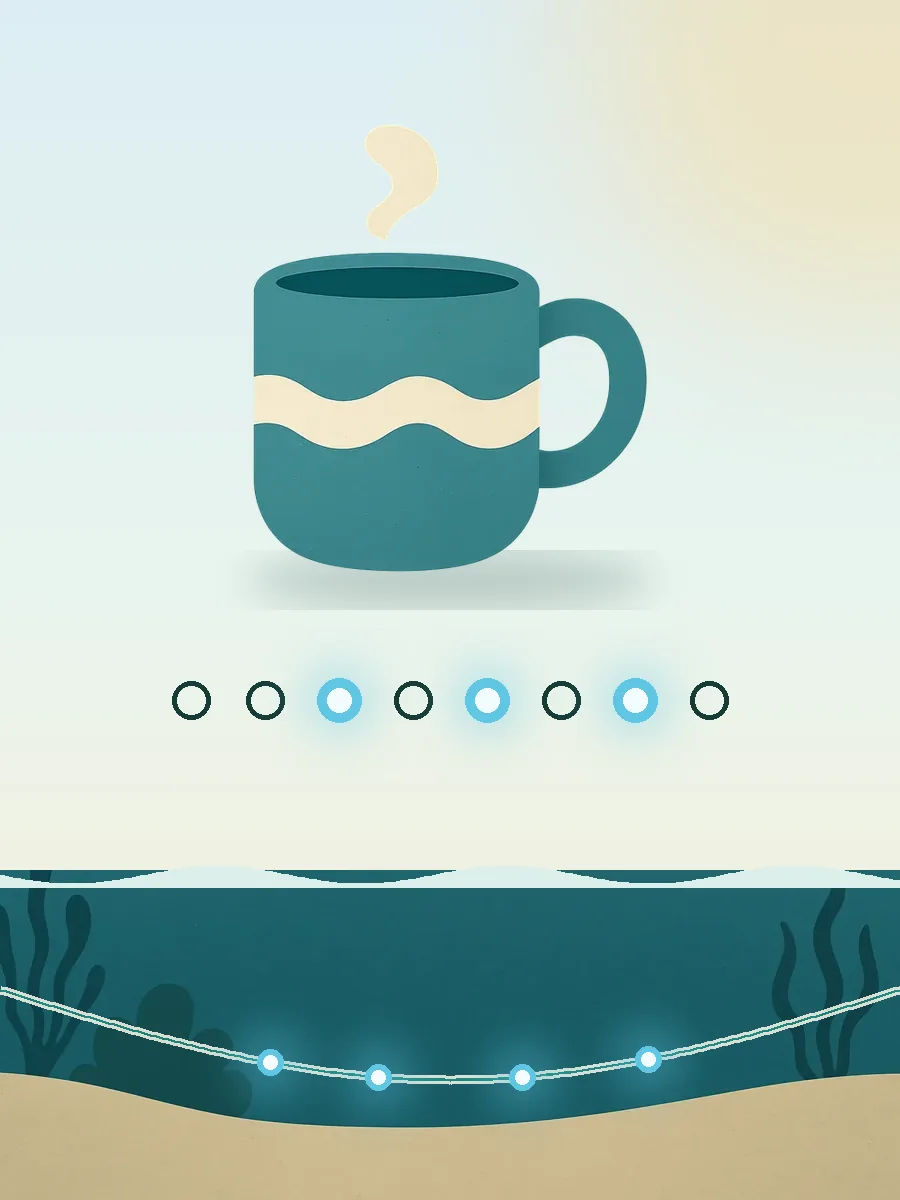
What does a computer actually do? Not what most explainers imply: it
never turns your cup into light. It builds a symbolic representation
of the cup, then represents that symbolically again and again — picture,
base ten numbers, base two numbers, light — until it reaches something a
cable can carry. One long shore walk makes the case, bottom of the ladder
first — no steps, no arrows, just scroll. Four mini-games,
each worth a gold star: flip a grid of pixels over to discover that every
picture is secretly a spreadsheet of red-green-blue numbers; drive a pair
of odometers — base ten and base two counting in lockstep, with a gold
carry-of-one that visibly flies to the next column whenever a wheel runs
out of symbols (bonus star at 42, and a side demo rewriting 42 as
00101010 to show why base two matters); then answer the real question —
why ones and zeros at all? — by composing your own byte on eight bit
switches and sending it down a wire that eats it bit by bit, 1 leaving
as a flash of light, 0 as darkness, until it reassembles on the far
side.
The finale puts it all together as a story you drive one click at a time: Noah in Israel wants to show Sam in America his cup, right now. The cup can’t travel — its picture can. A single button walks the whole crossing, naming each translation as it happens: take a picture, see the spreadsheet on Noah’s phone, translate to binary, send it as light along the cable between the two shores, back to ones and zeros, back to base ten — until the cup pops onto Sam’s screen.
The easter egg lives where it should: double-tap the ocean. You become the receiving phone in a full-screen arcade — light pulses stream along the cable, and you tap exactly when a flash crosses the ring while letting the darks drift by. Catch eight good bits and a letter arrives; the bits you’re catching really are the message, character by character, spelling HELLO FROM ISRAEL.
A first for this family: the cup, the kids, and the undersea scene are AI-generated storybook art from a one-anchor-then-reference pipeline, all squeezed to about 190 KB of WebP. Everything else — phones, stations, pulses, wheels, the arcade — is hand-drawn in code, in the same seaside palette as its siblings.
Want someone who builds like this?
I'm open to opportunities. Tell me what you're building — I answer every email.